

You do not have to choose a program today. Use this guide to prepare the questions that matter before you do.
General information for U.S. families, not individual tax, investment or benefits advice. Rules checked October 30, 2026.
Find your starting point
- “Could my child qualify?” Start with eligibility.
- “Will this affect SSI?” Separate the account balance from withdrawals.
- “I’m comparing programs.” Use the questions before opening.
- “What happens to Medicaid?” Read the Medicaid and remaining-funds section.
Who is eligible for an ABLE account?
For a child, the first question is which qualifying route applies. A diagnosis or an IEP alone does not establish ABLE eligibility.
Route 1: Qualifying disability benefits
The benefits route includes SSI based on blindness or disability, including certain people whose SSI is suspended only because of income or resources. It also includes qualifying Social Security disability benefits, such as childhood disability benefits. Ordinary dependent or survivor payments are not, by themselves, the disability-benefit route. SSA explains the qualifying benefits.
Route 2: Disability certification
A person who is not receiving those benefits may qualify through disability certification. The impairment route requires a medically determinable physical or mental impairment causing marked and severe functional limitations, expected to result in death or lasting, or expected to last, continuously for at least 12 months. Qualifying blindness is a separate route within the certification rules.
The certification is made under penalty of perjury. It includes confirmation that a physician-signed diagnosis is held; keep that diagnosis and follow the program’s documentation instructions. Disability-certification requirements.
The onset-age rule: Since January 1, 2026, the qualifying blindness or disability must have begun before age 46, rather than before age 26. This is an onset rule, not a requirement to open the account before the 46th birthday. It matters especially when you are checking eligibility for an adult family member. Current SSA guidance.
A question to use: “Which eligibility route fits the information we have, and what does your program require us to certify or keep?”
Whose account is it?
The eligible person is the account owner and beneficiary, even when someone else helps manage it. For a minor child, a person with the appropriate signature authority can establish and administer the account. Signature authority does not transfer ownership. SSA account-ownership rules.
Ask the program who may act for your child, what paperwork is required and what changes when your child becomes an adult. Do not assume that a parent, guardian and Social Security representative payee have interchangeable roles.
For the wider decision-making conversation, see turning 18 and alternatives to guardianship.
The 2026 contribution limit
2026 base annual limit: $20,000 in total from all contributors. This is the combined amount, not a separate allowance for each parent or relative. The separate federal annual gift-tax exclusion is $19,000 for 2026. The two figures are different. IRS Revenue Procedure 2025-32, sections 4.34 and 4.42.
An eligible working account owner may be able to contribute extra. That additional amount is limited by the owner’s compensation and the applicable one-person poverty guideline for the preceding calendar year, with retirement-plan conditions. Ask the program to confirm the amount and conditions for the correct year and place of residence. Federal contribution rules.
Make one shared contribution record. Before someone adds money, note who is contributing, the amount and the date. Ask the program how it handles approaching the limit or correcting an excess contribution.
This block covers 2026. Check the current year’s IRS limit before making contributions in a later year.
How does an ABLE account affect SSI?
Three different questions can get mixed together. Check each one separately.
Money going in
Putting income into an ABLE account does not erase SSI income rules. Wages or other income can still count as they normally would, even when deposited directly into the account. SSA POMS, section C.1.
Ask: “Before this money reaches the account, does it count as income for SSI, and what do we need to report?”
Money staying in the account
SSI disregards the first $100,000 of an ABLE account balance. The amount above $100,000 counts toward the SSI resource limit. If countable resources exceed the limit, SSI cash payments can be suspended. Other resources and eligibility conditions still matter. SSA’s SSI explanation.
Ask: “How does the ABLE balance fit with my child’s other countable resources?”
Money coming out
A withdrawal is called a distribution. For SSI, it is not income. But money withdrawn for housing or a nonqualified expense counts as a resource if it is still held in the following month. SSA POMS, section D.2.
Before a housing withdrawal: Check when the payment will actually leave the account receiving the money. Ask SSA or a qualified benefits adviser how the dates affect your situation. Do not assume that every withdrawal has the same rules as money left inside the ABLE account.
Starting with SSI itself? Our child SSI application guide explains that separate process.
Medicaid and money remaining after death
When SSI payments are suspended specifically because the ABLE balance creates excess resources, Medicaid can continue if the person remains otherwise eligible. That protection does not settle other eligibility problems or every state Medicaid situation. Ask the Medicaid agency how the rules apply to your child. SSA’s Medicaid explanation.
There can also be a Medicaid claim after the account owner dies. Federal law permits a state claim against remaining ABLE funds for Medicaid assistance paid after the account was established, subject to the statutory limits and payment of outstanding qualified disability expenses. State practices can differ. Federal Medicaid-claim provision, section 529A(f).
Before opening, ask the program for its written Medicaid-payback disclosure and ask your state Medicaid agency about its current policy. Keep the answer with the account papers.
What can the money be used for?
Qualified disability expenses are related to the beneficiary’s blindness or disability and benefit that person. Federal categories include education, housing, transportation, employment support, assistive technology, health and personal support services. Federal expense definition, section 529A(e)(5).
A category is a starting point, not a decision about every purchase. Before an unclear expense, ask the program or a qualified tax adviser:
- How does this expense fit the qualified-expense rules?
- What documentation should we keep?
- Are there tax or benefits consequences if it is not qualified?
- Does the timing of the withdrawal matter for SSI?
A simple record: Keep the receipt, date, amount, purpose and related account transaction together. Avoid spreading the information across several family text threads.
For funding routes beyond your own savings, see SSI, Medicaid and equipment support.
Compare the program, not just the headline
Use the same questions for each program you consider. Write down the answers beside the date and the document or person you got them from.
- Can a family in our state enroll, and does our home state offer something we should compare?
- What are the enrollment, maintenance, transaction and investment-related fees?
- Is there a minimum deposit or balance?
- How quickly can we access money, and how do withdrawals work?
- What risks apply to the choices offered? Is any option insured, and under what terms?
- What statements and contribution alerts will we receive?
- Who can help if we make a mistake or our child’s circumstances change?
- What does the program’s Medicaid-payback disclosure say?
Some state programs accept residents of other states; confirm a particular program’s enrollment rules rather than assuming all do. SSA program overview.
For a large inheritance, trust, settlement or complicated benefits situation, bring the documents to a qualified adviser before moving money. This guide does not choose between an ABLE account and a special needs trust for your family.
Before you open an account
You can use this list during a call. An unanswered item is a question to resolve, not a reason to guess.
- [ ] We have identified the eligibility route and the records to keep.
- [ ] We know who owns the account and who may manage it.
- [ ] We have checked the current contribution limit and how relatives will coordinate deposits.
- [ ] We have asked about income, the account balance and withdrawal timing separately.
- [ ] We have checked Medicaid questions, including the state’s payback policy.
- [ ] We have read the fees, access rules and risk information.
- [ ] We know where receipts, statements and written answers will be kept.
Start the conversation: “I’m looking at an ABLE account for my child. Before I enroll, I want to confirm eligibility, who can act on the account, and how it fits with our benefits. Can you walk through those questions with me and point me to the written rules?”
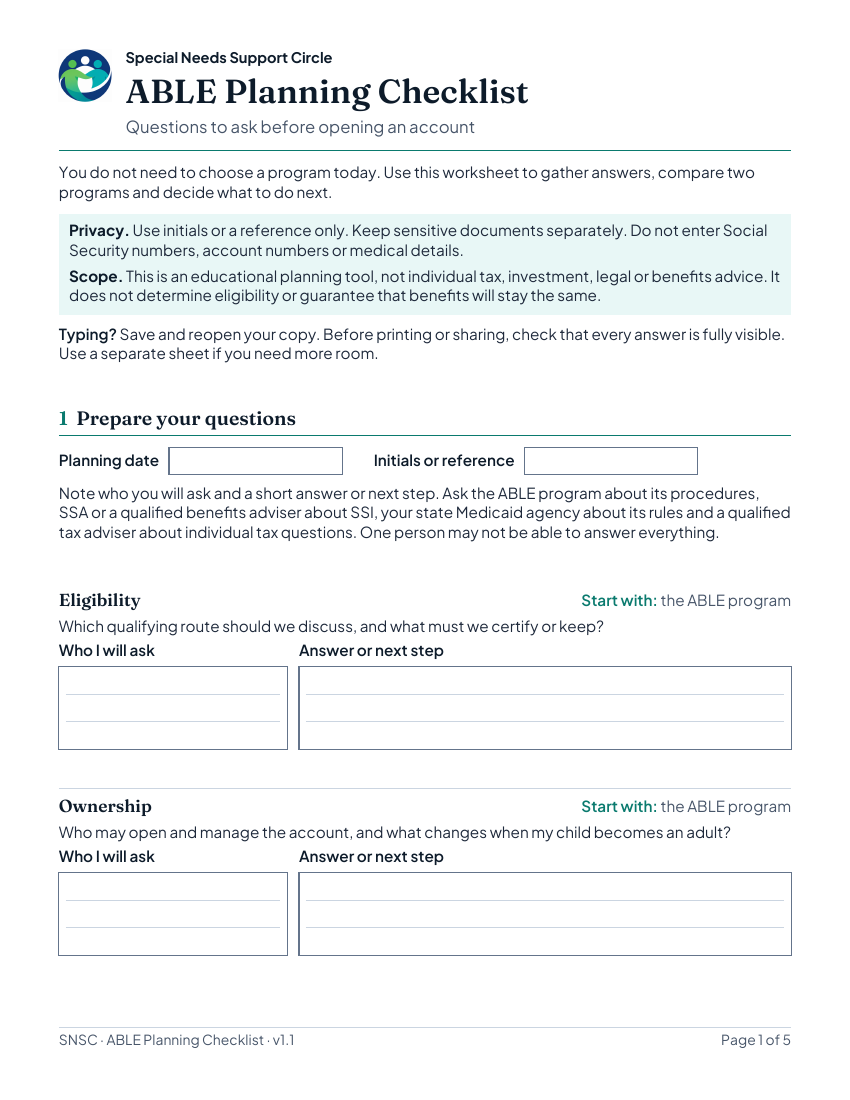
Preview · Page 1 of 5
Preview page 2
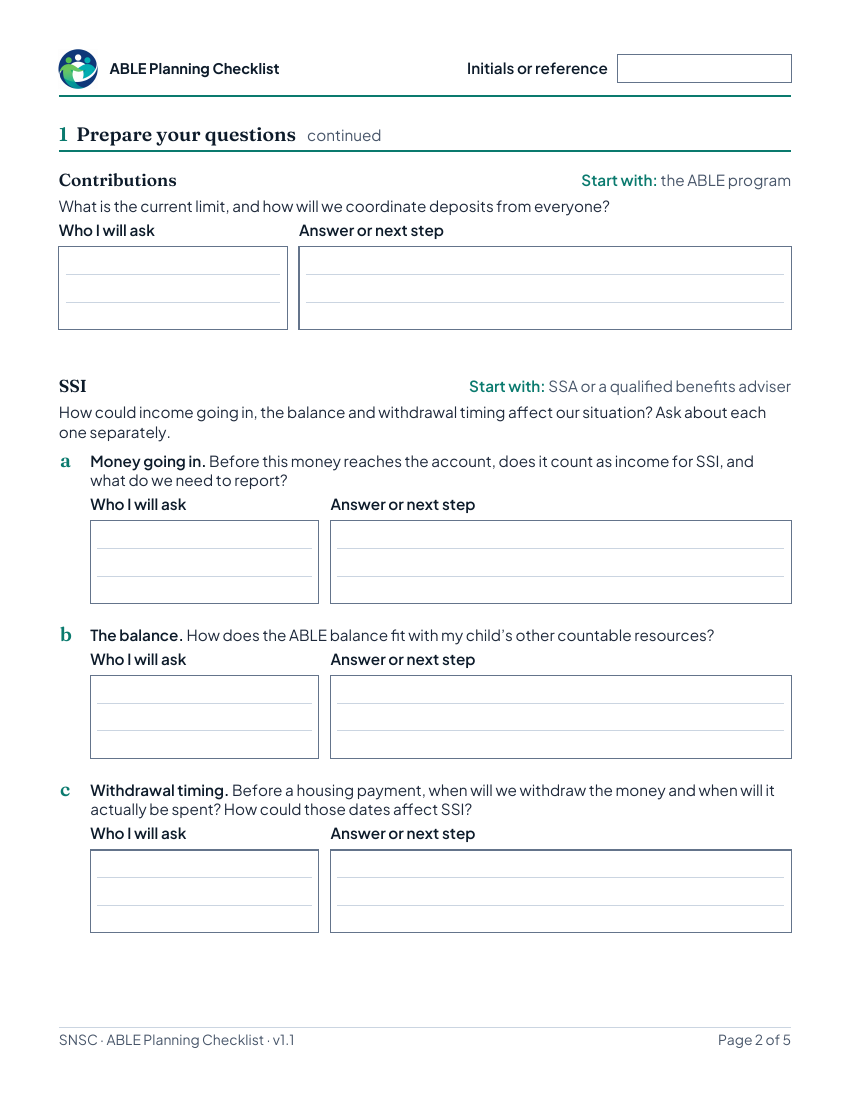
Preview · Page 2 of 5
A LITTLE LESS TO HOLD IN YOUR HEAD
Take one question at a time
The free ABLE Planning Checklist gives you a place to gather answers, compare two programs and choose a next step. You do not need to choose a program today.
Five pages, with a fillable PDF and a print edition. Use initials or a reference only, and keep sensitive documents separately.
Enter your email to request the checklist, then check your inbox for the next step.
You’ll receive the requested resource by email. See our Privacy Policy.
This is an educational planning worksheet, not individual tax, investment, legal or benefits advice. You can read this guide and use its questions without signing up.
Questions parents ask
Does my child need to receive SSI first?
Not necessarily. Disability certification is another qualifying route. Check the complete eligibility requirements above with the program; a diagnosis alone is not the whole test. Certification rules.
Is the $20,000 limit for each person who contributes?
No. The 2026 base limit combines contributions from everyone. Ask the program separately about the additional contribution rules for an eligible working owner. IRS 2026 limits.
Does opening an account guarantee that benefits will stay the same?
No. Check income, resources, withdrawals and other eligibility rules for the benefits your child receives. The SSI and Medicaid sections above explain why an account is not a blanket guarantee.
What should I ask if my child is approaching 18?
Ask who will be authorized to manage the account, how your child will participate and whether any paperwork needs updating. Use our adulthood guide for the wider conversation about decision-making support.
Sources and review
Prepared by Special Needs Support Circle. Sources checked October 30, 2026. This is general educational information; no individual eligibility or financial outcome has been determined.
- IRS Revenue Procedure 2025-32: 2026 contribution and gift limits
- SSA POMS SI 01130.740: ABLE accounts and SSI
- SSA ABLE account overview
- 26 U.S.C. 529A: current ABLE law
- 26 CFR 1.529A-2: certification requirements
The current statute and SSA guidance control the age-46 rule; older age wording remains in the regulation. The 2026 dollar figures above use the IRS procedure because some summary pages contain inconsistent amounts.