

Start with what you know, what your child has shared and what you need checked. Write to the school, ask what support will be in place and agree on when you will hear back.
Start with what your child needs now
If your child is in immediate danger, call 911. Do not wait for an email response or a school meeting in an emergency. Emergency help: 911.gov
For the school conversation, start small:
- What does your child want you to understand?
- Where or when do they feel worried about returning?
- Which adult would they feel comfortable approaching?
- What would help them explain what happened: speech, writing, pictures, a communication device or another familiar way?
You can say: “Thank you for telling me. I want to understand, and I’ll help you talk to the people who need to know.” Avoid promising a particular outcome or asking your child to handle the other child alone.
Keep a short, factual record
A few clear notes are more useful than trying to write the whole story perfectly. Use a private document or notebook. Keep what you observed separate from what someone told you.
When and where
Date, approximate time, classroom, bus, playground or online space
What happened
Actions or words; use your child’s own words where you can
How you learned about it
“I saw…” / “My child told me…” / “The teacher reported…”
Who was told
Name, role, date and how you contacted them
What followed
The response, any agreed support and the next check-in
School impact
Missed school, difficulty joining activities, changes in work or missed services
Save relevant messages or screenshots with their dates. Keep them private rather than posting other children’s names or accusations online. You do not have to know the other child’s intention to describe an incident accurately.
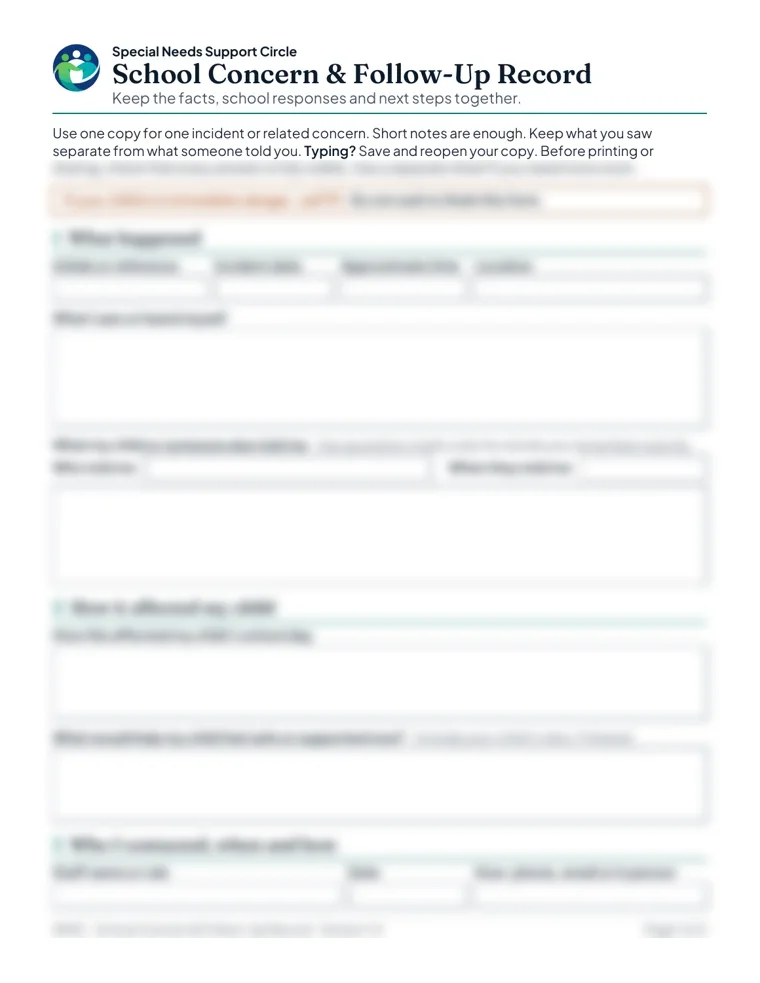
Preview · Page 1 of 2
Preview page 2
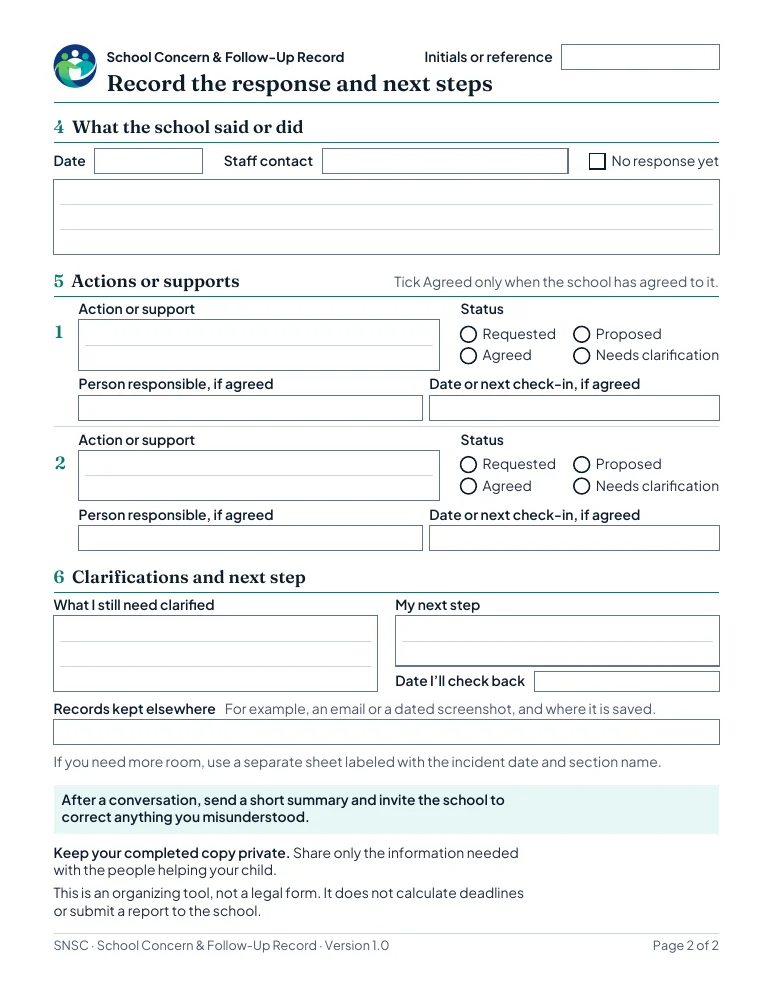
Preview · Page 2 of 2
A LITTLE LESS TO HOLD IN YOUR HEAD
Keep the concern and the follow-up together
The free School Concern & Follow-Up Record gives you room for what happened, your child's perspective, who you contacted and what happens next.
Two pages. Choose the fillable PDF or the print-only copy. Use one record for an incident or related concern, and share only what is needed.
Enter your email and check your inbox for your free record. Both PDF editions are included. No account is needed to use them.
You’ll receive the requested resource by email. See our Privacy Policy.
This is a personal organizer, not a formal school complaint or emergency reporting service. You can read this guide and use the on-page message example without signing up.
Tell the school in writing
Use the school’s reporting process if it has one. Ask who should receive your concern and keep a copy of what you send. This example is a starting point, not a legal form.
Check your school district’s current bullying-reporting policy and your state’s reporting, investigation and appeal timelines. Start with StopBullying.gov’s state-by-state laws and policies, then confirm the current requirements with your state education department and district.
A message you can adapt
Before sending: Replace the brackets, remove anything that does not fit and attach only the relevant records. Ask for a response date; this example does not set a legal deadline.
Ask what will change during the school day
An answer such as “we’ll keep an eye on it” can leave a lot unclear. Ask what that will look like for your child.
- Arrival, breaks and transport: Who will be available in the places where concerns have come up?
- A trusted adult: Who can your child go to, and what happens if that person is absent?
- A usable way to report: How can your child ask for help without having to explain everything in front of other students?
- Participation: How will your child keep access to lessons, activities and classmates?
- Follow-through: Who will tell you what support was put in place and whether it is helping?
Ask how the response will avoid making your child carry the burden of preventing the bullying. If a change of classroom or routine is suggested, ask why, what alternatives were considered and how your child’s views will be included.
Bring the school impact to the IEP or 504 team
There are two related concerns to keep separate. Disability-based harassment can raise civil-rights issues. Bullying on any basis can also interfere with a student with a disability’s access to educational services and may result in a denial of a free appropriate public education, or FAPE. Not every incident automatically establishes a federal violation. U.S. Department of Education: bullying and harassment
You do not need to decide the legal label before explaining the impact to the team. Bring specific examples: attendance, participation, work, communication, services or difficulty getting through the day.
Try: “Since these incidents, we’ve noticed [change]. Can the team review whether the current supports still meet my child’s needs and what needs to change?”
For the wider process, see our IEP guide for parents. If you are unsure which plan your child has, start with IEP vs. 504 plans. For organizing the discussion, use how to prepare for an IEP meeting.
If the first response is not enough
Reply with the dates of your earlier reports, what was agreed and what is still happening. Ask who reviews unresolved concerns under the district’s policy. Keep the focus on the incidents and the support your child needs.
A short follow-up: “I reported this on [date]. We agreed on [step]. Since then, [new incident or unresolved concern]. Please confirm what has happened so far, who is responsible for the next step and when we will review it.”
Your state’s Parent Center is another place to ask for help understanding school processes.
A report to the school and a federal civil-rights complaint are different processes. For OCR complaints, use the Department of Education’s current filing instructions, including its deadlines and available submission methods. Do not assume a school discussion pauses an outside filing deadline.
If the online form does not open, the official instructions also describe other submission methods. For context on agency changes, see federal special education changes; use the official filing instructions for your actual next step.
If your child is also being sent home or suspended
Keep a separate record of school removals as well as the bullying incidents. Ask the school to explain the reason for each removal in writing.
Our school discipline and suspension guide covers that different set of questions. This page does not decide whether a particular disciplinary response was lawful.
Questions parents ask
What if my child cannot explain exactly what happened?
Share the pieces you have and say what is still unclear. Ask how the school will help your child communicate and check what happened. Avoid filling gaps with guesses. Include your child in a way that works for them, without repeatedly asking them to retell a difficult event.
What if the school says it was a conflict, not bullying?
Ask which policy it is using and how it reached that conclusion. You can still ask what happened, how your child will be supported and how the concern will be reviewed. Keep the conversation tied to specific actions and school impact rather than arguing only about a label.
Can I bring this up at an IEP meeting?
Yes, you can ask the team to discuss how these incidents are affecting school and whether support needs to change. Bring your short record and the questions that matter most. What to say at an IEP meeting can help you prepare the conversation.
What should I keep?
Keep your reports, replies, relevant screenshots, meeting notes and agreed next steps together. Date each entry. After a conversation, send a short summary and invite the school to correct anything you misunderstood.
Your next step
You do not have to solve the whole situation in one message. Start with one clear report and a request for a named contact and a check-in date.
Sources and scope
This is practical preparation and general U.S. education information, not a decision about your child’s legal rights in a particular case. State rules and school policies may add other processes.
- U.S. Department of Education: Disability Discrimination—Bullying and Harassment
- ED: October 21, 2014 guidance on bullying of students with disabilities, currently linked from the official issue page
- ED: How to file a discrimination complaint with OCR
- StopBullying.gov: youth with disabilities and special health needs
- 911.gov: Calling 911
Source check: October 30, 2026. No legal or clinical professional review is claimed.