.avif)
When Special Needs Parenting Strains Your Marriage
Special needs parenting puts real pressure on a marriage. That pressure is common, it is not proof your relationship is broken, and there are specific things that help — even when time and energy are nearly gone.



By Special Needs Support Circle
Practical caregiver guidance informed by the real questions, patterns, and lived experiences shared across the SNSC community of 64,000+ families.
Last updated: May 2026
Special needs parenting can put real pressure on a marriage because caregiving often turns partners into exhausted co-managers. Appointments, school meetings, therapy schedules, money stress, sleep loss, and constant decision-making can crowd out connection.
You used to be partners.
Somewhere along the way — between the appointments and the school calls and the hard nights and the insurance disputes — you became co-managers.
You talk about logistics. You divide tasks. You pass each other in the hallway and exchange information instead of connection.
This is one of the least-talked-about parts of special needs caregiving. Not because it is rare — it is extremely common — but because naming it can feel like admitting something is wrong, and neither person has the time or energy to open that door.
This guide is not here to alarm you. It is not going to lead with divorce statistics or tell you that your relationship is in danger. It is here to help you understand what is actually happening, why it makes sense given what you are carrying, and what small things can help — without asking you to do more than you can.
Why this is so hard on a marriage — and why it is not about who you married
The strain that special needs parenting puts on a relationship is not usually about incompatibility. It is about structural pressure that would challenge any two people.
Sleep deprivation changes everything. Chronic sleep loss affects mood, patience, empathy, and the ability to regulate emotion. Two people who are both chronically depleted do not have the resources to be generous with each other — even when they want to.
The caregiving load is constant and unpredictable. There is no end point, no finish line, no clear break. Every week brings new appointments, new challenges, new paperwork, new decisions. The relentlessness itself is exhausting in a way that is hard to explain to anyone who has not lived it.
Money stress compounds everything. Therapies, equipment, evaluations, medications, specialized programs, missed work, and insurance fights can turn ordinary disagreements into much heavier conversations.
School and system conflicts are draining. Fighting for services, preparing for IEP meetings, navigating denials, managing relationships with schools and providers — this is emotionally exhausting work that rarely gets acknowledged as such.
Intimacy disappears gradually. Physical intimacy, emotional intimacy, and even simple companionship get crowded out by the demands of caregiving. Two people can share a home and a life and still feel profoundly alone.
There is no time to repair after conflict. In most relationships, a difficult conversation can be followed by some recovery time. In a caregiving household, the next hard thing starts almost immediately. Conflict accumulates without resolution.
None of this is a personal failing. It is the predictable result of carrying something enormous with very little structural support.
What this pressure does to a relationship over time
The changes happen slowly, which is part of why they are hard to see until they have been accumulating for a while.

Conversations become logistics
The child’s schedule, the upcoming appointment, who is picking up, what needs to happen tomorrow. The relationship starts to function more like a business partnership than a marriage.

Resentment builds quietly
Small imbalances accumulate. One person feels they are carrying more. The other does not see the full picture. Neither says it directly because saying it out loud feels like starting a fight.

Emotional distance sets in
Not because either person stopped caring, but because connection requires time and energy that the caregiving system keeps consuming.

Scorekeeping replaces conversation
Each person privately tracks what they do, what the other does not do, and how unequal it feels. The score never gets discussed. It just shapes every interaction.
Avoiding conversations becomes a pattern. Hard conversations get postponed indefinitely — not because there is nothing to say, but because neither person has the bandwidth to say it and recover from it. Silence becomes easier than honesty.
Feeling alone even when the other person is there. This is one of the loneliest experiences in caregiving — being in a relationship, having a partner present, and still feeling fundamentally unseen and unsupported.
What tends to make things harder, even with good intentions
Most of the things that compound relationship strain in caregiving families are understandable. They are not signs of a bad partner. They are signs of two depleted people trying to manage an impossible situation without enough tools.
Silent tallying. Keeping a private count of everything you do and everything the other person does not do — without ever surfacing it. The resentment grows. The other person has no idea. Nothing changes.
Assuming the other person should just know. The expectation that a partner should recognize what is needed and when — and interpreting the failure to do so as indifference or laziness rather than blindness.
Trying to solve the whole relationship at night. Raising every unresolved issue at the end of an already exhausting day, when neither person has any capacity left. These conversations rarely go well.
Comparing exhaustion. “I am more tired than you.” “You have no idea what my day was like.” Both people are exhausted. Competing over who is more depleted leaves both people feeling unseen.
Making every conversation a defense. When one person raises a concern, the other responds by listing everything they do. Now the conversation is about defending rather than solving.

When the load is not shared equally — and why that matters
In most caregiving families, one partner carries significantly more of the caregiving load than the other.
This is sometimes a practical reality — one person has more flexible work, more proximity, more established relationships with providers. But it is also sometimes invisible.
 remembering the medication schedule
- tracking the next IEP date
- knowing which therapist said what last Tuesday
- managing insurance calls
- anticipating what might go wrong
- planning for transitions, meltdowns, school meetings, and appointments before anyone else sees the problem
Some caregiving work is visible: driving to therapy, giving medication, attending IEP meetings, making dinner, and handling appointments. But much of the load stays hidden: tracking deadlines, researching providers, remembering medication changes, anticipating hard moments, reading school emails, preparing for meetings, and holding the mental list.
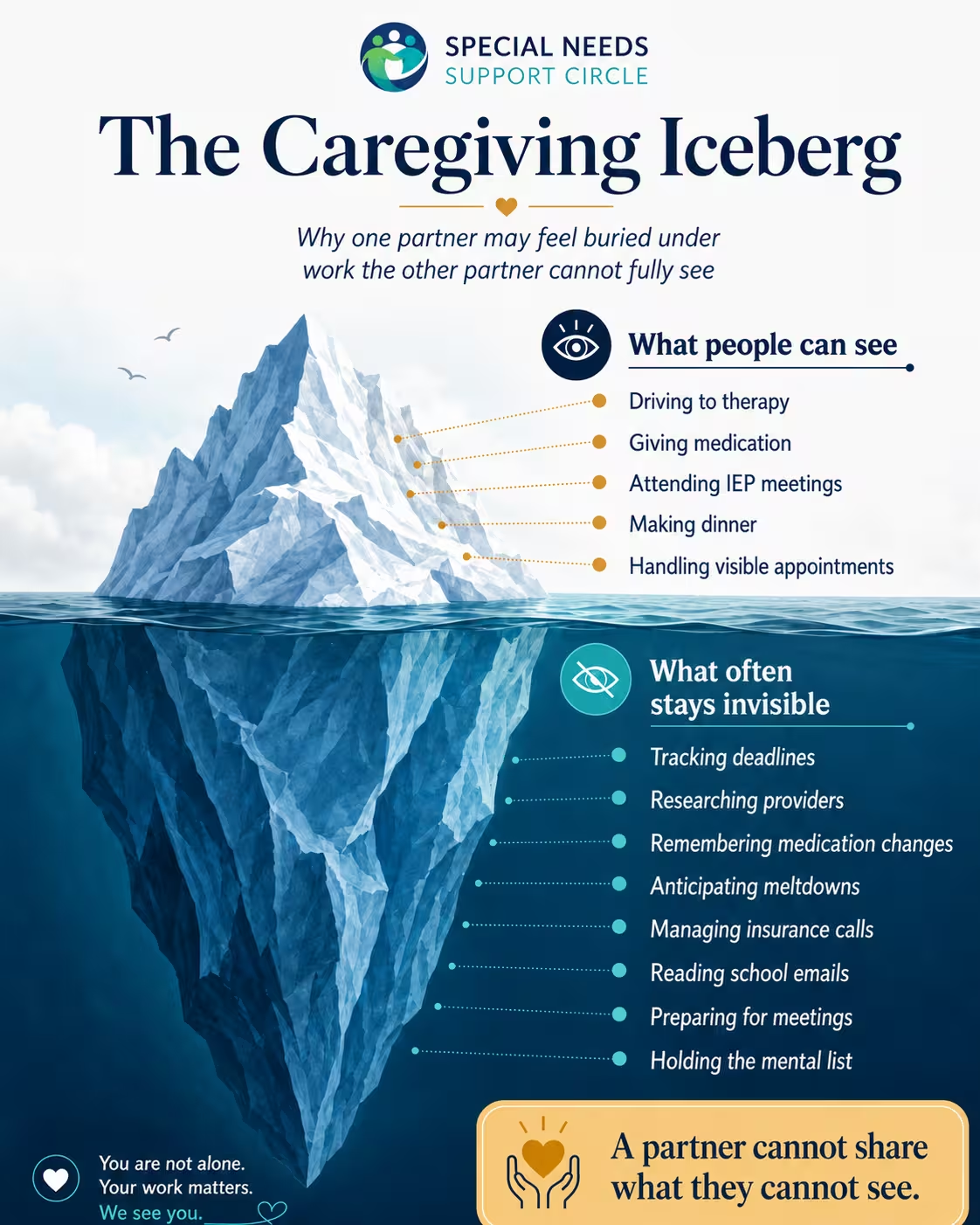
A partner cannot share what they cannot see.
If your partner literally cannot see the load you are carrying, writing down every task, appointment, and mental-overhead item is not about keeping score.
It is about making the invisible visible so they understand what they are actually being asked to share.
The partner carrying this load often feels:
- like the case manager of the family, not a co-parent
- like asking for help requires more energy than just doing it themselves
- resentful of having to explain or delegate instead of actually share
- invisible in their effort to everyone, including their partner
- frightened about what happens if they stop
The goal is not perfect equality. It is shared ownership — where both partners are genuinely responsible for their portion, without reminders, without the other person managing every handoff.
Try this
The Mental Overhead Brain-Dump
This is not about proving who does more. It is about making the invisible visible.
Take five minutes and write down what you are carrying in these areas:
- Appointments I track
- School / IEP items I manage
- Medical or therapy tasks I remember
- Insurance or benefits items I carry
- Household tasks tied to caregiving
- One task my partner could fully own this week
Then choose one task to transfer. Not everything. One thing.
How to have the conversation without it becoming a defense
The conversations that need to happen are genuinely hard — not because the people are difficult, but because both people are tired, both feel unseen, and both have accumulated grievances that are real.
Start smaller than a relationship overhaul. Pick one issue. Pick one time when you are not both destroyed. Make one clear ask.
Scripts to keep the door open
When the load feels unequal
→ “I do not want this to become a fight. I need us to look at the load together.”
When you need to name what you carry
→ “I am not saying you do nothing. I am saying I cannot keep being the only person who carries the mental list.”
When you need one thing to change
→ “Can we pick one thing this week that you fully own without me reminding you?”
When you miss the relationship
→ “I miss us. But I am too tired to pretend we are fine.”
When the conversation becomes defense
→ “I need help, not a defense.”
When you need to name the distance
→ “I do not think either of us is doing this on purpose. But I think we have been running the household instead of being partners, and I want to figure out how to change that.”
- “I am too tired to have this conversation well right now. Can we pause?”
- “I am sorry I snapped. I am not mad at you. I am overwhelmed.”
- “I do not want to fight. I want us to get back on the same team.”
- “Can we try this conversation again tomorrow, when we are not both running on fumes?”
One rule for hard conversations: Do not start this conversation at 11 PM when you are both running on fumes. Pick one issue, keep it short, and make one clear ask. You do not have the energy for a complete relationship overhaul tonight.
What actually helps — kept realistic for people with nothing left
Advice that assumes time, energy, and emotional bandwidth that caregiving families do not have is not useful advice. These are things that can help in the actual conditions most caregiving couples are living in.
Action card
The 10-minute non-logistics check-in
One task fully transferred. Not helped with. Not reminded about. Fully owned by one partner — from noticing it needs to happen through completing it — without the other person managing the handoff.
One protected rest block per person. Each partner has one block of time per week that is genuinely theirs. Not caregiving time. Not household management time. Not “I’ll rest while still listening for everything.” Actual off-duty time.
A shared calendar or checklist that both people actually use. Getting the mental load out of one person’s head and into a shared system removes a significant source of resentment. It is not romantic. It is functional.
One repair sentence after conflict. Not a full resolution. Not an apology tour. One sentence that keeps the door open: “I do not want us to stay here.” “I am sorry I said that the way I did.” “Can we try again tomorrow?”
One outside support layer if possible. Respite care, a trusted family member, a neighbor who can help, a caregiver-support community — anything that creates even occasional breathing room. The relationship cannot repair itself if there is never any space between the caregiving demands.

Send Me the Respite Handoff Sheet
If someone can step in so the two of you can rest, talk, or stop managing for a little while, the free Respite Handoff Sheet gives the person stepping in everything they need before they arrive.
When the relationship needs more than you can give each other
There are points in a relationship’s strain that go beyond what the two people inside it can navigate alone. Recognizing that point is not failure — it is information.
Couples therapy can provide a structured space to have conversations that keep collapsing at home. A therapist who understands the specific pressures of caregiving families is preferable to a general couples counselor.
Individual therapy for each partner independently can be as valuable as couples therapy. Each person carrying caregiver burnout, grief, resentment, or fear benefits from a space that is entirely theirs.
Respite care is not a luxury. It is infrastructure. A couple that never gets a break from the demands of caregiving has no space to remember who they are outside those demands. Even a few hours can change what is available between two people.
Caregiver support communities — including the SNSC community of 64,000+ families — provide connection with people who understand the specific texture of this life. Knowing you are not alone in what you are experiencing is not a small thing.
🆘 Important safety boundary
Communication advice, load-mapping, and relationship strategies are not adequate tools when there is fear, control, threats, emotional abuse, physical harm, substance misuse, or financial control present in the relationship. These are safety issues, not communication issues.If any of these are present, this guide is not enough. Please reach out to the National Domestic Violence Hotline at 1-800-799-7233, visit thehotline.org, or text START to 88788. If you are in immediate danger, call 911.
If you are doing this without a partner — or without a real one
Not everyone reading this guide is in an intact marriage where both partners are present and trying. Some caregivers are:
Married but effectively alone. A partner who is physically present but emotionally unavailable, unwilling to engage with the child’s needs, or checked out of the caregiving reality. This can be lonelier than actual single parenthood because the help is supposed to be there and is not.
Being the only functioning caregiver inside a two-person marriage carries a specific kind of grief. You may be mourning the partnership you thought you had while still having to execute the daily labor. You are not wrong for feeling profoundly lonely.
Separated or divorced. Caregiving through a co-parenting arrangement that was already strained before the relationship ended, or navigating a split that the caregiving pressure contributed to. The grief here is real and often goes unacknowledged.
Single parents. Carrying the full caregiving load without a partner at all — by choice, by circumstance, or because the relationship could not survive. The absence of a partner to share this with is a genuine loss, and naming it matters.
In a relationship where the topic cannot be raised. Some partners will not engage with the conversation this guide is trying to have. That is also a real situation, and it deserves acknowledgment.
If you are in any of these situations, the sections on what helps are still relevant — adapted to a single-person context. Building a support network, finding respite, protecting small recovery moments, and connecting with others who understand your situation all apply. You are not outside the reach of what this guide is trying to offer.
Questions caregivers ask about relationships under this pressure
You are not failing your relationship
The fact that caregiving has put pressure on your marriage is not evidence that you chose the wrong person or that your relationship is fundamentally broken. It is evidence that you are carrying something enormous, mostly without enough support, and that the relationship has been absorbing the cost.
What many couples in this situation need is not just a better relationship — it is more support around the caregiving itself. Less relentless pressure. More breathing room. A few small reliable moments that are not about managing.
Start with one thing. Name one truth. Transfer one task. Protect ten minutes.
That is where repair begins.
Disclaimer: This guide is for general educational and caregiver-support purposes only. It is not medical, legal, mental health, relationship, or safety advice, and it is not a substitute for professional counseling, legal guidance, or emergency support.
Keep going with caregiver support
If this guide touched something real, the full Caregiver Support guide can help you find the next practical step — burnout, respite, mental health support, and ways to carry less alone.