

Start with the hours you need, a short description of your child’s support needs and a few direct questions for each provider. You do not need to hand over a full medical history to begin that conversation.
First, name the care you need
Write down the days, hours, location and start date you are looking for. Include school closures, transport and pickup arrangements if they matter to your schedule.
Then separate the main job:
- Routine childcare: care while you work, study or manage daily life.
- Before- or after-school care: support around the school day, including the handoff between school and the program.
- A break from caregiving: start with our respite care guide. Some arrangements can serve both needs.
- Education during school breaks: see extended school year services, rather than treating an educational service as a childcare plan.
If you need several kinds of help, keep them on separate lines. That makes it easier to see what a provider has actually agreed to cover.
Where to start looking
Begin with your state’s childcare or early childhood agency. Ask for its provider search, licensing information and local referral help. Check the provider’s current hours and openings directly rather than relying only on a directory entry.
ChildCare.gov is a national starting point. If it does not load, search for your state government’s childcare agency and ask for the official search and licensing routes.
An example, not a nationwide directory:Texas Child Care Connection links families to provider searching and inspection records. Use your own state’s system outside Texas.
For after-school care, also ask the school who actually operates the program. A program on school grounds may have a separate provider. You will need to know whom to contact about support, fees and unresolved concerns.
Keep a short list: provider, age group, hours, contact, current opening or waitlist, questions still unanswered. A search result or license entry does not tell you whether the particular arrangement will work for your child.
Describe your child in a useful way
A short introduction can help you move beyond “Do you take children with special needs?” Try describing what a normal afternoon would involve.
“We need care on [days/hours]. My child enjoys [interest]. They communicate by [method] and need help with [specific tasks]. Could we talk through how those things would work in your program?”
Include what is relevant:
- How your child communicates and asks for help.
- Moving around, seating or access needs.
- Eating, toileting or other personal-care support.
- Transitions, busy spaces and what helps your child join in.
- Supervision and any existing safety or health instructions the provider needs to discuss with you.
- What your child enjoys and what they want staff to know.
If toileting is part of that support, our guide to planning toileting support can help you prepare questions about routines, privacy and coordination with caregivers.
Share sensitive information privately with the people who need it. Keep clinician instructions separate from this everyday introduction. For communication preparation, see AAC for parents.
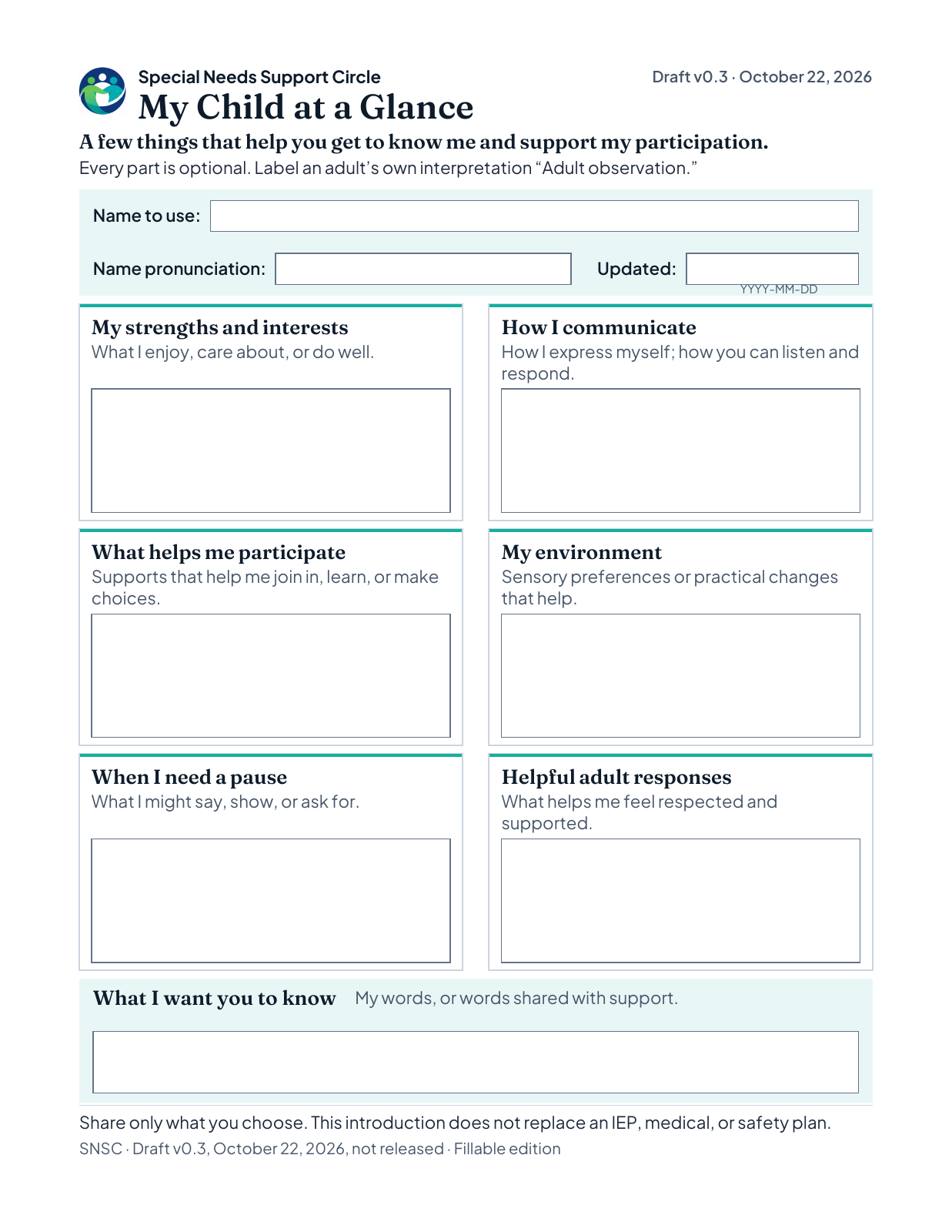
Preview · My Child at a Glance
A PRACTICAL TOOL TO KEEP HANDY
Share what helps someone get to know your child
A one-page introduction with space for what matters to your child, how they communicate and what helps. Fill in only what you want to share with a childcare provider.
This is an everyday introduction, not a medical care plan or a guarantee that a provider can meet every need.
Enter your email and check your inbox for your free My Child at a Glance.
You’ll receive the requested resource by email. See our Privacy Policy.
See what is included in My Child at a Glance. You can read this guide without signing up.
Questions to ask a provider
You do not have to ask every question in one call. Start with the support that cannot be left unclear.
Who will help, and how?
- Who would help with [specific task] during an ordinary day?
- Who covers that role when the usual staff member is away?
- What training or written instructions would you need before my child starts?
- How would my child ask for help using their usual communication method?
What would the day actually look like?
- Can we talk through arrival, activities, meals, bathroom routines and pickup?
- How do you include a child who needs a different way to join an activity?
- What happens when a routine changes or my child is having a difficult day?
- How would school staff and after-school staff hand over information?
What do we need to agree on?
- What are the hours, fees, closure dates and cancellation terms?
- What is included in the fee, and what would any additional charge cover?
- Who decides requests for changes or support?
- How will we share concerns and review the arrangement?
When you visit
Notice whether the explanation matches what you see. Can your child use the spaces they need? Is personal care handled privately? Do staff speak with your child, not only about them? Ask about anything that feels unclear.
This is a conversation checklist, not a safety certification or a provider endorsement.
If a provider says they cannot support your child
Ask for the specific concern and what changes were considered. “We don’t take children with disabilities” is different from a discussion of a particular support need.
Who runs the program matters: Covered private childcare centers fall under ADA Title III; state- or local-government programs fall under Title II. Religious-controlled programs are exempt from Title III, but an independent provider renting religious premises generally is not. Other laws may apply. DOJ childcare guidance, questions 1–2
Under DOJ guidance, admission decisions require an individualized assessment, not assumptions about a diagnosis. Reasonable modifications have limits, including fundamental alteration and direct-threat considerations; the ADA generally does not require hiring extra staff. DOJ, questions 3–7
Try: “Could you explain the particular task you are concerned about, what modifications you considered and who can discuss possible arrangements with us?”
A Head Start label alone does not establish who operates the program. Ask rather than assuming it is government-run.
If the explanation remains unclear, use the DOJ ADA information route for help understanding the general rules. This guide cannot determine whether a particular refusal is lawful or promise admission, a place or an aide.
Costs and assistance: ask what applies to you
Ask for a written breakdown of regular fees, optional services, deposits and what happens if the arrangement ends.
A covered provider cannot add a surcharge for services the ADA requires; services beyond those requirements are different. This does not make ordinary childcare free. DOJ, question 13
For childcare subsidies, the federal Child Care and Development Fund (CCDF) rule requires priority for children with special needs, as defined by the Lead Agency, alongside other priority groups. That priority does not guarantee your child’s eligibility or an available funded place. 45 CFR 98.46
Ask the state agency: “How do you define special needs for priority, what proof do you need and how do your eligibility and waiting-list rules work?”
Head Start programs generally must ensure that children eligible under the Individuals with Disabilities Education Act (IDEA) make up at least 10% of total actual enrollment, unless HHS grants a waiver. This is a program requirement, not an individual promise of admission. Ask the local program about eligibility, selection and openings. Head Start enrollment rule
Make the first-week handoff clear
Before the start date, put the arrangements you discussed in one place. Keep this simple enough for the person doing the handoff to use.
The everyday support
Task, person responsible and backup
Communication
How your child asks for help and how staff contact you
Arrival and pickup
Who hands over, transport details and authorized contacts
Separate instructions
Where staff can find any agreed health or safety instructions
A check-in
Who will review the arrangement with you and when
This record organizes the conversation; it is not a medical care plan. Ask how your child’s perspective will be included at the check-in. If something is not working, describe the specific difficulty and ask what can change.
Questions parents ask
Does my child have to be toilet trained?
There is no single answer for every program. DOJ distinguishes centers already providing toileting help from those that never do; reasonable modifications or alternative arrangements may be relevant. Ask about your child’s actual needs rather than accepting a blanket age rule. DOJ, questions 15–16
What about medication or health instructions?
Ask who reviews the instructions, what staff can carry out, what training is needed and who provides backup. Ask to speak with the program’s decision-maker about any concern. Keep the child’s clinician involved in health instructions; this guide does not tell staff how to give medication or perform a procedure.
What if my child needs one-to-one help?
Ask what that help would involve throughout the day, which tasks are already covered and what additional arrangements could be discussed. Do not treat an informal “we should be able to” as a completed plan. The staffing limit is explained in the support-concerns section.
What if every program has a waiting list?
Ask how each list works, whether you need to check back and whether it covers your child’s age and schedule. Keep looking through your state’s referral route while you wait. Write down the next check-in so you do not have to remember every conversation.
Can I change providers if the arrangement is not working?
Start by reviewing the agreement and identifying what needs to change. Ask for a discussion if that feels useful. If you decide to move, clarify notice, fees and the handoff of relevant information. You do not need to turn a poor fit into a judgment about your child.
Your next step
Pick the three questions that matter most for your child and use them in your next call. Clear answers about an ordinary day are more useful than a general promise to be inclusive.
See questions to ask a provider
For the wider picture of support around your family, return to Caregiver Support.
Sources and scope
This page helps you prepare and compare arrangements. It is not a placement service, legal opinion or guarantee of availability. State rules and individual programs vary.
- U.S. Department of Justice: Commonly Asked Questions About Child Care Centers and the ADA
- 45 CFR 98.46: Priority for child care services
- 45 CFR 1302.14: Head Start selection process
- Office of Head Start: FAQs about the 10% enrollment requirement
- Texas Child Care Connection: Finding child care, a state-specific example
Source check: October 30, 2026. No legal, clinical or childcare inspection review is claimed.