

A few practical changes can give you somewhere to begin. You do not need to work on every step at once. This guide offers general starting points and questions for the people helping with your child’s care, rather than a fixed training schedule.
General information for U.S. families, not an individual medical or toilet-training plan. Sources checked October 30, 2026.
Start with the concern in front of you
Pain or a concerning change? Contact your child’s clinician about pain, possible constipation or a new difficulty, rather than assuming your child is resisting. If you believe there is a medical emergency, call 911. The American Academy of Pediatrics explains constipation and getting help.
For everyday support, choose the route closest to what you need:
- “I don’t know what to try first.” Go to what often helps.
- “My child needs physical help.” Look at the bathroom routine.
- “Different adults are doing different things.” Prepare a shared support conversation.
- “Something has changed or the plan isn’t helping.” Use the questions for your child’s clinician.
What often helps
Choose one manageable starting point. Keep your child’s comfort and way of communicating at the center.
Make clothing easier
Where suitable for your child, try clothes that are easy to move up and down, such as loose trousers with an elastic waist. Keep spare clothes nearby. HSE preparation guidance.
Show what happens next
Use a short sequence of familiar pictures, words or objects to explain the routine. Keep any visual steps where your child can use them. HSE preparation guidance.
For example, ask the team helping your child: “Would a few familiar pictures help here? How should we show asking for help or finishing?”
Notice how your child communicates
Pay attention to gestures and other ways your child shows they need the bathroom or help. Use simple, familiar language rather than a long set of instructions. HSE practical tips.
If your child uses augmentative and alternative communication (AAC), ask their communication team how to include bathroom words, discomfort and requests for help in the system they already use. Our AAC guide for parents offers a broader starting point.
Agree on the cues adults will use
Share the plan with the people helping your child. Notice your child’s usual patterns rather than imposing a timetable from a generic chart. HSE preparation guidance.
A useful question is: “Can we use the same short cue and write down what help we are offering?”
Encourage without pressure
Use encouragement your child enjoys and notice their efforts. Avoid pressure around toilet training, especially when constipation is a concern. HSE practical tips and AAP constipation guidance.
Keep accidents private. Clean up calmly and return to the agreed plan rather than making the moment a public score or punishment.
Ask what is appropriate for your child now
Talk with your child’s clinician about readiness, physical comfort and any equipment or support needs. AAP guidance for children with special needs.
You can begin that conversation with: “Which part should we work on first, and what would tell us the approach needs changing?”
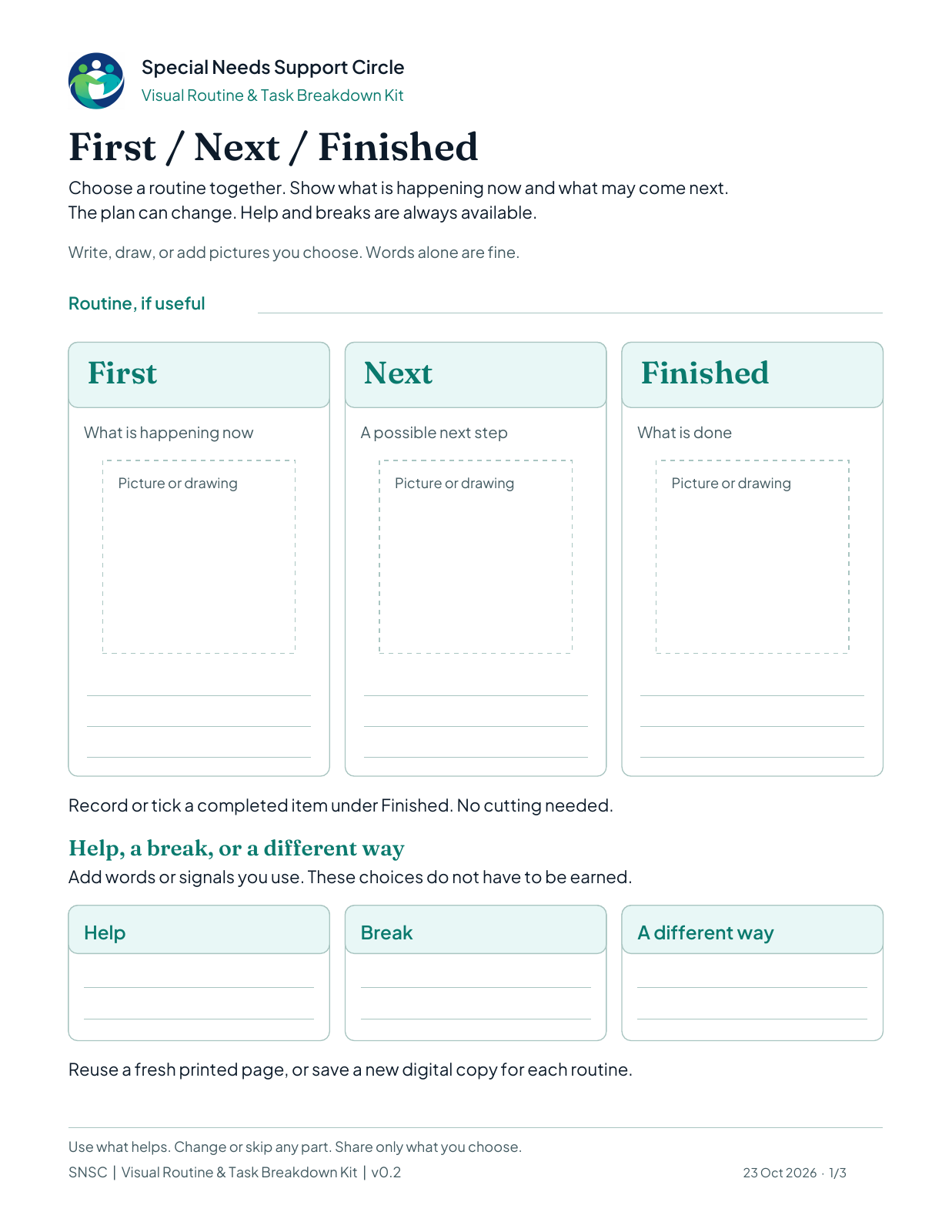
Preview · Routine board
Preview the small-step planner
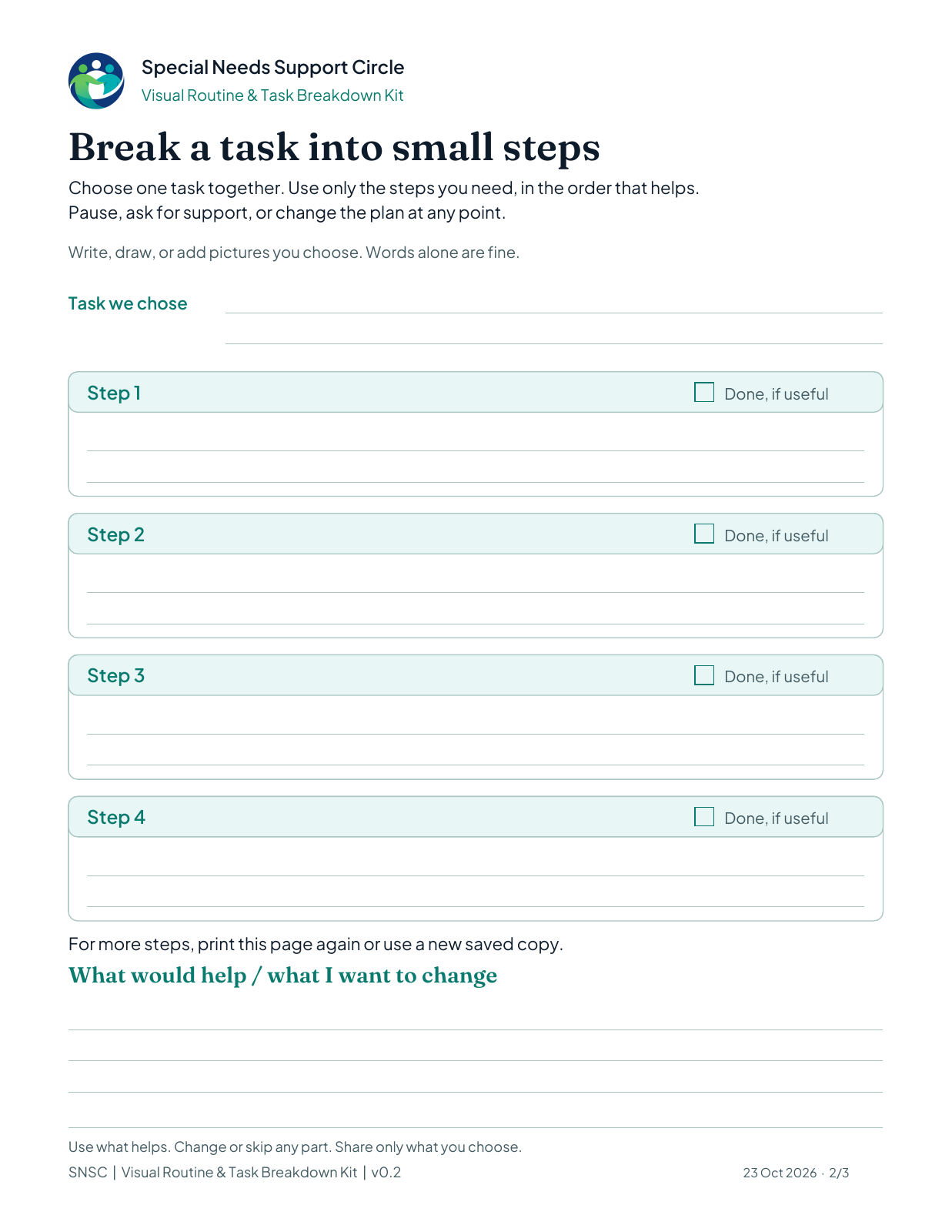
Preview · Small-step planner
A PRACTICAL TOOL TO KEEP HANDY
Make one routine easier to talk through
Use a First / Next / Finished board, a small-step planner and optional support choices to talk through a routine with the people who help your child.
This is general visual routine support, not a toilet-training program, treatment plan or readiness test. Use it alongside the guidance agreed with your child's care team.
Enter your email and check your inbox for your free Visual Routine Kit.
You’ll receive the requested resource by email. See our Privacy Policy.
See what is included in Visual Routine Kit. You can read this guide without signing up.
Prepare your questions for the clinician
You do not need a perfect diary before asking for help. Describe what you are seeing in everyday words and bring any observations you already have.
- Could pain, constipation or another health concern be affecting this?
- Is this change something you want to assess?
- Is there anything about my child’s medicines or health history we should discuss?
- Which part of the routine is appropriate to work on now?
- If my child needs treatment, should we change the toileting plan while it is happening?
- What should prompt us to contact you again, and who should we call outside office hours?
- Would another professional help with communication, access or physical support?
A short script: “We’re having difficulty with toileting. I’ve noticed [what happens] at [when or where]. My child communicates [what you see or hear]. Could we check comfort and health concerns, then agree on the next step?”
Follow the plan made for your child. This page does not tell every family to continue or pause training during constipation, and it does not recommend medicines, fluid targets or a treatment schedule.
Look at the whole bathroom routine
Walk through the routine with the people who help your child. You can use these as questions rather than a list of tasks your child must do independently:
- Getting there: Can my child reach and enter the bathroom with the help they need?
- Clothing: Which fastenings or changes need assistance?
- Position and comfort: Who can advise us about safe positioning, transfers or equipment?
- Communication: How will my child ask for help, show discomfort or say they are finished?
- Cleaning and handwashing: What help is needed, and who provides it?
- Privacy: How will we protect my child’s dignity while offering that help?
Ask a qualified professional to assess equipment, transfers or hands-on support for your child. A picture of an adaptation online cannot tell you whether it is suitable.
For broader support at home, see sensory strategies for home. Keep any toileting changes tied to what is actually difficult for your child, rather than assuming every difficulty is sensory.
Keep a small, private record if it helps
A few notes can help you explain a pattern to the care team. HSE’s preparation guidance suggests recording toileting patterns and sharing useful observations with the professionals involved. Read the preparation guidance.
You might note:
- Date and setting.
- What your child communicated.
- Any discomfort you noticed.
- Which part of the routine needed help.
- What support was offered and what happened afterward.
- The question you want to ask.
Keep only what is useful. Store it privately and share it with the people who need it for your child’s care. A brief note is enough; you do not need photographs or a public progress chart.
If the plan is not helping
Bring the specific difficulty back to the clinician or support team. It is more useful to say “The clothing step is still difficult” or “My child becomes upset before entering this bathroom” than to label your child uncooperative.
Ask:
- Have we checked comfort and health concerns?
- Is the support realistic for my child right now?
- Are adults using the same plan?
- What one change should we try, and when will we review it?
If you are stretched thin, say so. “I can manage one change this week. Which should it be?” is a reasonable way to start. Our caregiver support page is there for your needs too.
Questions parents ask
What can we try first?
Start with one practical obstacle, such as difficult clothing or an unclear sequence. The starting points above offer simple options. If there is pain or a new health concern, begin with your child’s clinician instead.
What if my child does not use spoken words?
Ask how their gestures, pictures, objects or existing AAC can be used for the bathroom routine and requests for help. You do not need to invent a new communication system on your own. See our AAC guide.
What if my child needs physical help?
Ask the care team to look at the steps that need assistance, including getting to the bathroom, positioning, clothing and cleaning. Get individual guidance before choosing equipment or a transfer technique.
Should home and school follow the same plan?
Ask the adults involved to agree on clear cues, responsibilities and a way to share concerns. Write down any differences between settings so the team can work through them together.
How long should toilet training take?
This guide does not set a deadline for your child. Ask their clinician or support team what a realistic next step looks like and how you will know whether the approach is helping.
Sources and review
Prepared by Special Needs Support Circle. Sources checked October 30, 2026. General educational guidance, not a personalized clinical plan.
- AAP: toilet training children with special needs, updated May 26, 2022.
- HSE: preparing a child with additional needs for toilet training, reviewed November 14, 2025.
- HSE: practical toilet-training tips, reviewed November 14, 2025.
- National 911 Program: calling 911, emergency assistance information.
- AAP: constipation in children, updated July 10, 2024.
HSE is Ireland’s public health service. Its guidance is used here for general practical ideas, not U.S. school rights or eligibility rules.