

The quick answer
RTI means Response to Intervention. It uses information about how a student responds to instruction and extra help to guide the next teaching decisions. MTSS means Multi-Tiered System of Supports, a broader framework for organizing support across a school. Names and details vary by state and district. Colorado Department of Education · Massachusetts Department of Elementary and Secondary Education
Ask for the specific support, the skill it is meant to help, who will provide it and a date to review progress. You do not need to learn every acronym before asking those questions. State rules can change the next step.
Important: MTSS or RTI cannot be used to delay or deny a full individual evaluation for a child suspected of having a disability. Support and evaluation can happen at the same time. Government guidance explaining the federal requirement
RTI, MTSS and an evaluation are different things
RTI
“What instruction or intervention is changing, and what information will show my child's response?”
MTSS
“Which support is my child receiving within your school's system?”
Screening
“Is this a check to plan instruction, or are you proposing an eligibility evaluation?”
Special-education evaluation
“What suspected areas of need will the evaluation cover, and what consent paperwork is needed?”
A teacher or specialist's screening to choose instructional strategies is not an IDEA eligibility evaluation. Screening rule
A meeting called “MTSS” is a place to ask about the help being provided. Do not assume the meeting name tells you whether an IDEA evaluation has been requested or started. Ask directly and keep the responses separate in your notes.
What do the tiers mean?
You may hear “Tier 1,” “Tier 2” or “Tier 3.” Schools use tiers to describe different layers or intensity of support. In Colorado's model, additional supports supplement core instruction rather than replace it. Your district should explain how its own model works. Colorado's layered-support framework
Instead of focusing only on the tier number, ask:
- What does my child's school day look like with this support?
- What will be taught or practiced differently?
- What, if anything, will my child miss while attending it?
- How will you decide whether to continue, change or intensify the help?
Do not treat “Tier 3” as a diagnosis or a promise of special-education eligibility. The support label and the evaluation decision are different questions.
Ask for a plan you can understand
You can bring this list to a meeting or send it in a short message. These are practical questions, not a claim that every school must use this exact form.
The concern
“Which specific skill or part of the school day are we working on?”
Starting point
“What can my child do now? Can you show me an example?”
Support
“What will the teaching or support look like?”
Delivery
“Who will provide it, how often and for how long?”
Participation
“Is this individual or group support, and how does it fit into the school day?”
Progress check
“What will you measure, and how often will you share the results?”
Review date
“When will we meet or communicate again to decide the next step?”
Change rule
“What would tell you that this plan needs to change?”
Choose the two or three questions that matter most today. A shorter conversation with clear answers can be more useful than a long list no one gets through.
What should I look for in a progress update?
MTSS frameworks use progress information to help adjust support. Colorado's guidance also distinguishes whether the support was delivered as planned from whether the student improved. Both are useful questions. Massachusetts MTSS · Colorado progress and implementation guidance
Ask the school to walk you through one example rather than sending home an unexplained graph.
- “What is being measured here?”
- “What was the starting point, and what has changed?”
- “Were the planned sessions provided? Were there interruptions we should understand?”
- “Does this match what you see in class and what my child tells us?”
- “What will stay the same, and what will change before the next review?”
Write down the answer in everyday language. For example: “The team will try [support], [person] will share [information], and we will check again on [date].” This is an organizational example, not an intervention prescription or a required timetable.
If the answer is “we need more time”
You can ask what the extra time is meant to establish:
“I understand you want to review more information. What will be different during this next period, what will you measure, and when will we discuss the results? I am also concerned about a possible disability. Is the school proposing an evaluation? If not, please explain its decision in writing.”
If the school says it needs more intervention data to evaluate for a learning disability, ask how that fits the evaluation timeline. For a suspected specific learning disability, the evaluation group must consider appropriate-instruction information and repeated progress assessments shared with parents. In the circumstances described in 34 CFR 300.309(c), including whenever the child is referred for evaluation, the school must promptly request parental consent to evaluate and follow the applicable evaluation timeframes. An extension under that provision requires mutual written agreement between the child's parents and a group of qualified professionals; this does not replace the separate exceptions in 34 CFR 300.301. Specific learning-disability evaluation rule
You can request an initial evaluation while support is taking place. Whether your child is eligible for special education is a separate determination, not something this guide can decide. Initial evaluations
For the editable letter, consent paperwork and dates to track, use How to request a school evaluation.
Keep your child's experience in the conversation
Ask your child, in whatever way works for them, what feels easier, harder or different. You might ask: “What helps you get started?” or “Is there something you wish the adults understood?”
Bring their words or observations alongside school information. Keep observations separate from guesses about why something happened. If your concern involves safety, bullying or being sent home, use the guide for that situation rather than waiting for a routine progress meeting.
- Bullying and disability for documenting a concern and asking about the school response.
- School discipline and suspension for removals and repeated early pickups.
- Dyslexia school support for reading-specific questions.
- IEP vs. 504 Plan for the different school-support routes.
A short follow-up message
Subject: Next steps from [child's name]'s support discussion
Thank you for talking with me on [date]. My understanding is that the current concern is [concern], and the school will provide [support]. [Name or role] will share [progress information], and we will review it on [date].
Please let me know if I have misunderstood anything. I would also like to clarify [one unanswered question].
Thank you, [Name]
Copy the template, then replace the bracketed details before sending.
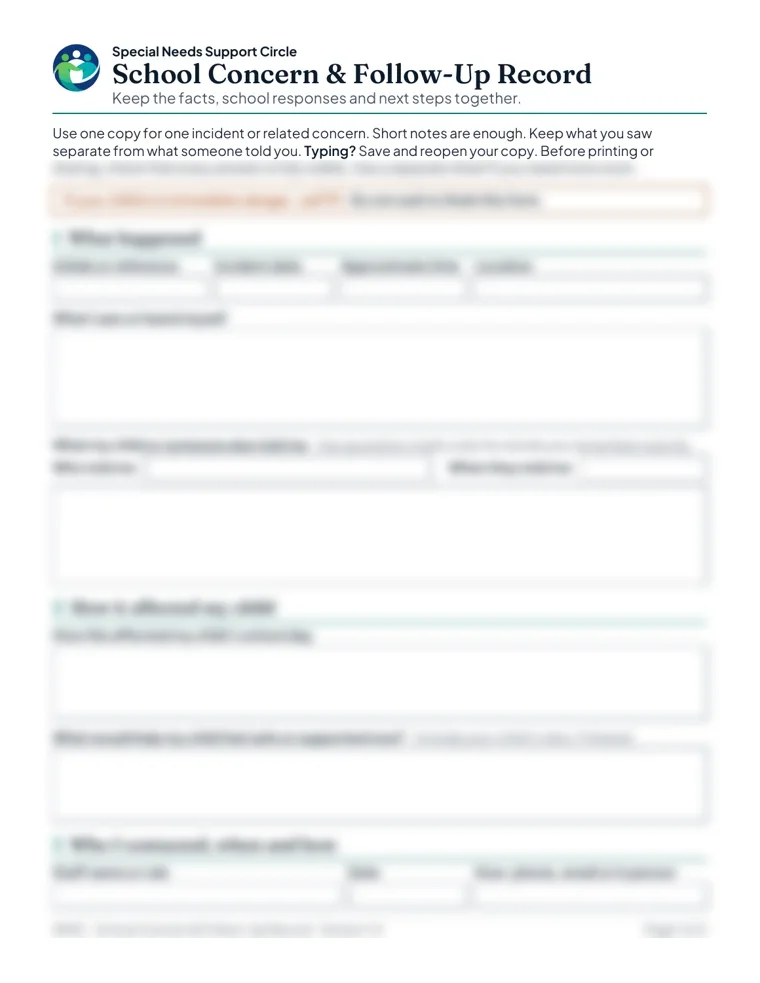
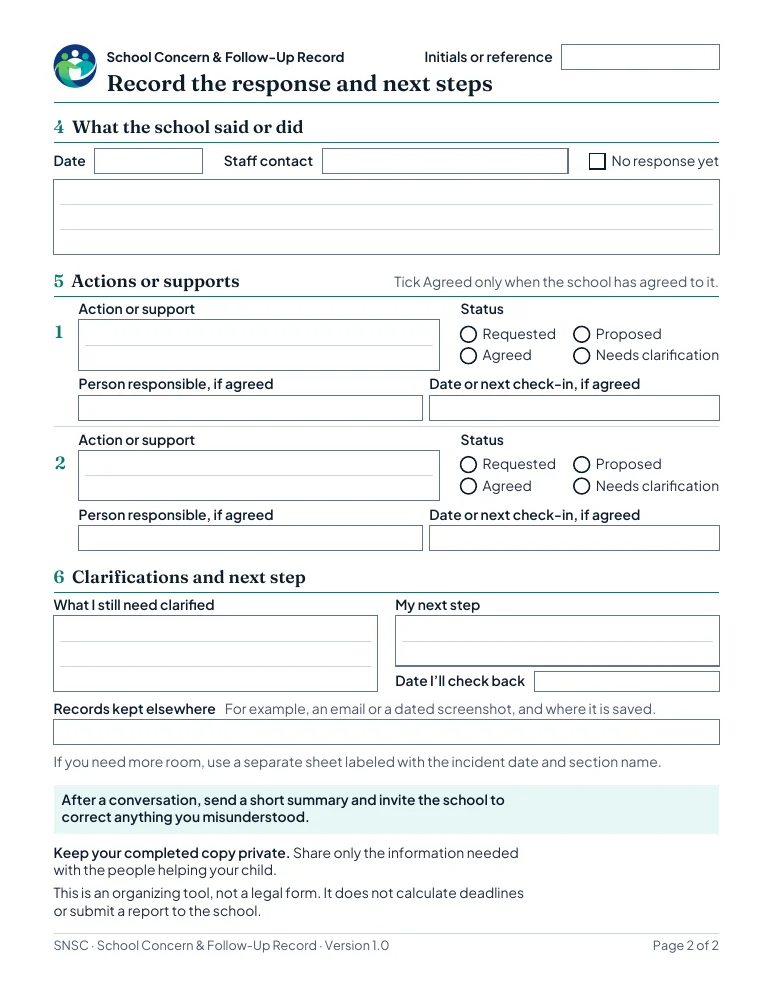
Keep the concern, school response and next step in one place. Get the free School Concern & Follow-Up Record. The questions and sample message on this page are available without signing up.
Preview · Page 1 of 2
Preview page 2
Preview · Page 2 of 2
A LITTLE LESS TO HOLD IN YOUR HEAD
Keep the concern and the follow-up together
The free School Concern & Follow-Up Record gives you room for what happened, your child's perspective, who you contacted and what happens next.
Two pages. Choose the fillable PDF or the print-only copy. Use one record for an incident or related concern, and share only what is needed.
Enter your email and check your inbox for your free record. Both PDF editions are included. No account is needed to use them.
You’ll receive the requested resource by email. See our Privacy Policy.
This is a personal organizer, not a formal school complaint or emergency reporting service. You can read this guide and use the questions on this page without signing up.
Common questions
Does RTI mean my child has a disability?
Not by itself. RTI describes a support and problem-solving process, not an IDEA eligibility decision. Ask what the school has learned about your child and whether it proposes an evaluation. RTI framework · Initial evaluation rule
Does my child have to finish every tier before an evaluation?
MTSS or RTI cannot be used to delay or deny a full individual evaluation for a child suspected of having a disability. Ask the school to address your evaluation request separately from its intervention plan. Government guidance
Does extra help have to stop during an evaluation?
No. Interventions can continue during an evaluation and provide useful information for it. Ask how the school will coordinate the support and evaluation. Government guidance
How long should RTI take?
This page does not set a universal number of weeks or intervention cycles. Ask your school what review period it proposes and why. If you suspect a disability, do not treat that review date as a reason you cannot ask for an evaluation now.
Who can explain the local process?
Ask the school's support-team contact, special-education office or your state Parent Center. For the wider school-support journey, start with the IEP Guide for Parents.
About this guide
This guide explains common U.S. school-support terms and federal IDEA evaluation protections. Schools and states organize support differently. Educational content only. Not legal, medical, or financial advice.
Sources checked October 30, 2026. Questions or a source correction? Contact Special Needs Support Circle.