

The quick answer
A parent can ask the school for an initial special-education evaluation. You can make that request before obtaining a medical diagnosis. Put your concerns in a dated message, describe a few examples and ask what happens next. Initial evaluations
Keep the request date separate from the consent date. The federal initial-evaluation timeline is 60 calendar days after the school receives parental consent, unless the state has established its own timeframe; specified exceptions can apply. Evaluation timeline · What “day” means
State rules can change the next step. An evaluation request does not guarantee eligibility or a particular service. The next useful step is getting a clear response, not trying to prove your child's whole case in one email.
Start with what is hardest at school
Pick two or three examples that help someone understand your concern. Include what your child says, when they can tell you, without making them responsible for explaining everything.
“Reading is hard.”
“My child can explain the story when I read it aloud, but cannot read the assigned paragraph independently.”
“Homework takes forever.”
“A short written assignment took [time], with [kind of help], on [dates].”
“School is overwhelming.”
“On [dates], my child described [concern], and the teacher reported [observation].”
These are examples, not diagnostic signs or eligibility tests. Separate what you saw, what someone told you and what you are concerned might be happening.
You can include a few relevant work samples or existing reports. Share only what is needed for this request, and ask the school about a secure way to send sensitive records. You do not need a complete file before you get in touch.
The evaluation must address all areas related to the suspected disability, and it cannot rely on one measure as the sole basis for deciding disability or the appropriate educational program. Evaluation procedures
Who should receive the request?
Check your district's special-education contact or evaluation-request instructions. If you cannot find them, ask the school office who handles parent evaluation requests. You can copy the principal and your child's teacher so everyone knows what you have asked.
Keep a copy of the message and attachments. Ask for receipt confirmation. If you speak by phone or in person, send a short written summary afterward: “Thank you for speaking with me today. This is what I am requesting.”
Copy-and-send evaluation request
Subject: Request for initial special-education evaluation — [child's name], [grade/school]
Dear [name or special-education team],
I am requesting a full individual initial evaluation under IDEA for my child, [name], who attends [school] in [grade]. I am concerned that a possible disability may be affecting their learning or participation at school.
Here are the concerns I would like the evaluation to address:
- [What you have noticed, with one example or date.]
- [What the teacher or your child has reported, clearly identified as their report.]
- [Support already tried and what you have noticed since, if known.]
Please consider all relevant areas of suspected need. I have included [brief list of relevant attachments, or delete this sentence].
Please confirm receipt and explain the district's next steps in writing. If the district proposes an evaluation, please send the prior written notice and consent paperwork, explain what will be evaluated, and tell me which state or federal timeline applies.
If the district refuses to evaluate, please provide prior written notice explaining the refusal and the information used to make that decision. Please also send the procedural safeguards notice and tell me whom to contact with questions.
I can be reached at [preferred contact details]. [Optional: Please communicate with me in [language or accessible format].]
Thank you, [Parent or guardian name] [Date]
Copy the template, then replace the bracketed details before sending.
Before sending: Replace the brackets, remove anything that does not fit and check the recipient. This is a starting template, not a required government form or a guarantee of a particular outcome.
The notice and consent requests above reflect IDEA's consent, prior-written-notice and procedural-safeguards rules. Consent · Prior written notice · Safeguards notice
Track these dates separately
Request sent
Date, recipient and where your saved copy is.
Request received
Any acknowledgment; if none arrives, ask who received it.
School response
What the district proposes or refuses, and any questions you still have.
Consent received by the school
Ask the district to confirm this date; it is not necessarily the date of your first email.
Applicable deadline
Ask the district to identify the rule, the date it calculates and any exception it believes applies.
Evaluation discussion
Meeting details, reports received and questions to bring.
The school generally needs informed parental consent before the initial evaluation. Consent to evaluate is not consent to begin special-education services. Parental consent
Your state may set its own timeframe and count it differently, so do not assume the federal 60 calendar days applies. Ask your district or state Parent Center which rule applies, particularly if your child changes schools or an exception is raised.
For a suspected specific learning disability, the extension described in 34 CFR 300.309(c) requires mutual written agreement between the child's parents and a group of qualified professionals. If you are asked to agree to that extension, ask why, for how long and what will happen during that time. This is separate from the other timeline exceptions described in 34 CFR 300.301. Learning-disability evaluation rule · Other timeline exceptions
What if the school says “try interventions first”?
MTSS or RTI cannot be used to delay or deny a full individual evaluation for a child suspected of having a disability. Supports can begin or continue while the evaluation takes place. Government guidance explaining the federal requirement · Initial-evaluation regulation
Ask: “Can the support continue while the evaluation request is considered? If the district is refusing the evaluation, please explain that decision through prior written notice.”
For help understanding the support plan and its progress checks, see RTI and MTSS at school.
What if the answer is no, or I have not heard back?
If the school refuses to initiate an evaluation, it must provide prior written notice explaining the refusal, the reasons and the information it relied on. Prior written notice
Read the notice alongside your original concerns. Write down what it answers and what is still missing. For a local explanation of your options, contact your Parent Center.
If you have no response, first verify receipt rather than assuming your message reached the right person. You can send:
On [date], I requested an initial evaluation for [child]. Please confirm that the district received my request and tell me its response and next steps. I have attached my original message for reference.
This guide does not assign one nationwide deadline for the school's response to your first message. Ask about the state rule instead of treating the evaluation-consent clock as the response clock.
After the evaluation: take the next step, not every step
Ask the team to explain its findings in everyday language and connect them to the concerns you raised. Note questions such as, “What did you learn about [specific difficulty]?” and “What support does the team recommend next?”
For eligibility, the IEP meeting and disagreements about an evaluation, continue with the IEP Guide for Parents. For the difference between school-support routes, see IEP vs. 504 Plan.
Keep the request, the response and your next question together. Get the free School Concern & Follow-Up Record. The copy-and-send letter above stays available without signing up.
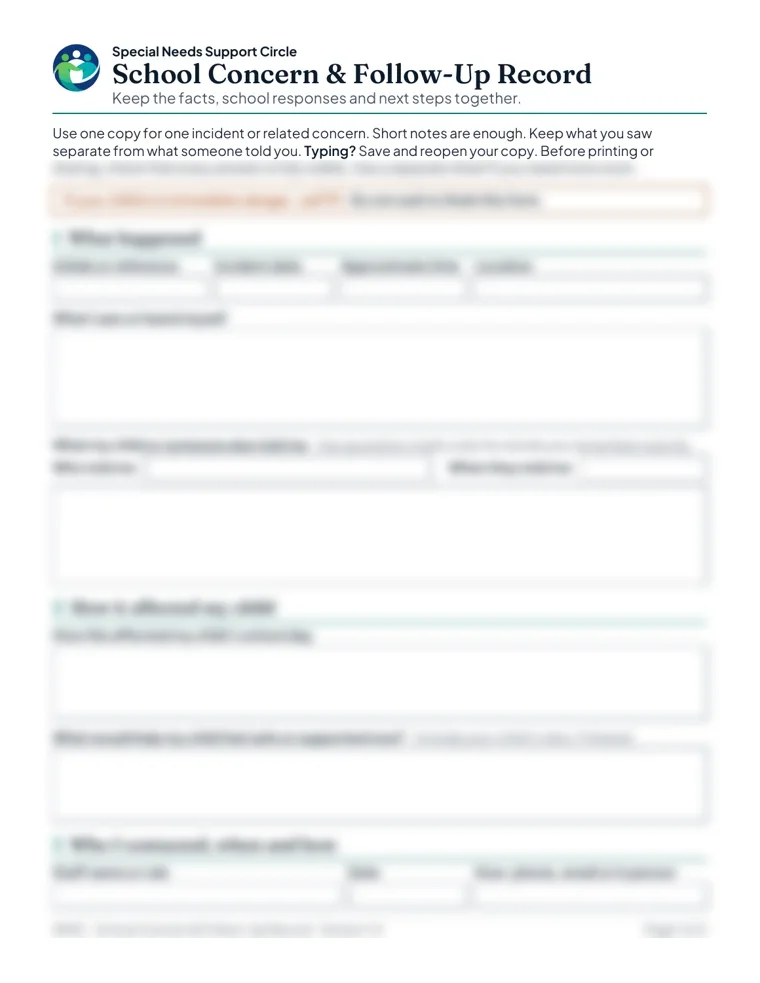
Preview · Page 1 of 2
Preview page 2
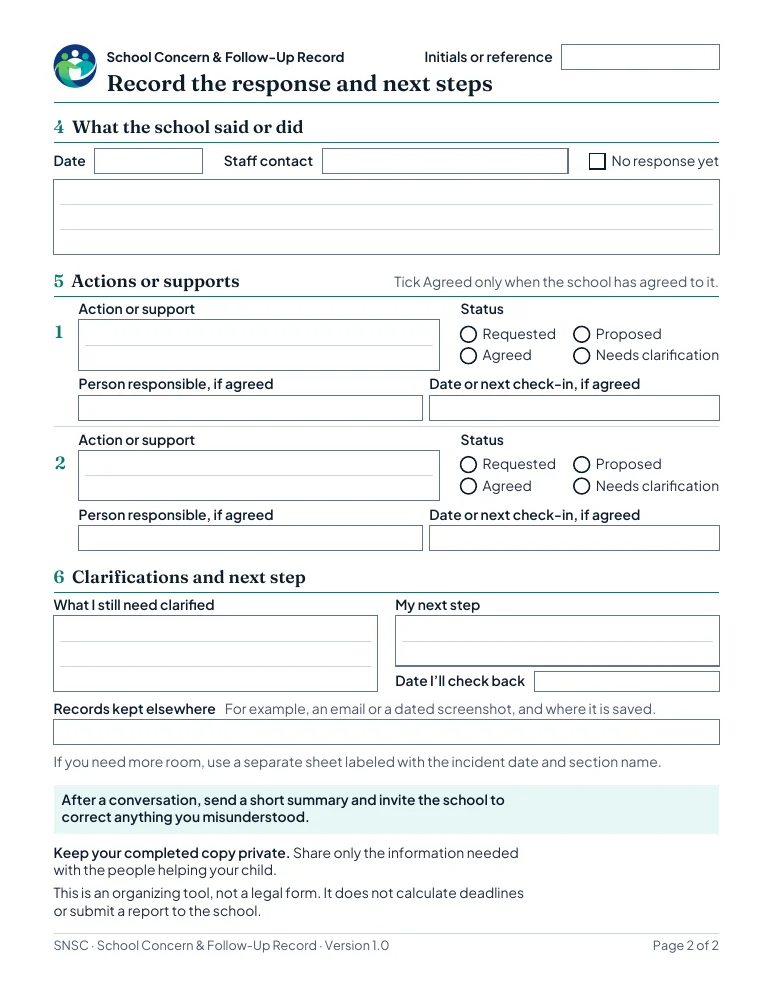
Preview · Page 2 of 2
A LITTLE LESS TO HOLD IN YOUR HEAD
Keep the concern and the follow-up together
The free School Concern & Follow-Up Record gives you room for what happened, your child's perspective, who you contacted and what happens next.
Two pages. Choose the fillable PDF or the print-only copy. Use one record for an incident or related concern, and share only what is needed.
Enter your email and check your inbox for your free record. Both PDF editions are included. No account is needed to use them.
You’ll receive the requested resource by email. See our Privacy Policy.
This is a personal organizer, not a formal school complaint or emergency reporting service. You can read this guide and use the on-page evaluation request without signing up.
Common questions
Can I ask for an evaluation if my child is passing their classes?
Passing from grade to grade does not by itself remove IDEA's child-find responsibilities for a child suspected of having a disability and needing special education. Describe the difficulty and support needed, rather than relying on grades alone. Child find
Is a school screening the same as this evaluation?
No. Screening by a teacher or specialist to choose instructional strategies is not an IDEA eligibility evaluation. Ask which process the school is describing. Screening rule
Does signing the request also consent to services?
No. The request, evaluation consent and consent for initial services are different steps. Read the paperwork before signing and ask about anything unclear. Consent rule
What if my child is younger than three?
Start with the Early Intervention guide, which explains the different route for babies and toddlers. This page is not a substitute for that process.
About this guide
This guide explains the U.S. public-school IDEA process. State procedures and individual circumstances can change the next step. Educational content only. Not legal, medical, or financial advice.
Sources checked October 30, 2026. Questions or a source correction? Contact Special Needs Support Circle.