.avif)
Dysgraphia Accommodations: Help When Your Child Knows It but Cannot Get It on Paper
Find where writing breaks down, match the barrier to support, and replace vague accommodations with language a school can actually implement.



Is this the page you need?
The whole guide in one minute
Dysgraphia is a commonly used term for writing difficulties involving handwriting, spelling, written expression, or the effort required to put ideas on paper. The key question is not whether handwriting looks messy; it is whether writing prevents your child from showing what they know. Support may include instruction, occupational-therapy input, typing, speech-to-text, a scribe, reduced copying, or different grading rules. This guide shows what to request and how to make the plan specific.
When is difficult handwriting more than messy handwriting?
The clearest clue is often the gap between what a child can explain aloud and what the child can produce on paper.
What part of writing is breaking down?
Writing asks a child to hold ideas, organize language, spell, form letters, control spacing, remember directions, and keep working at once. Support becomes clearer when you identify the breakdown.
Your child’s ideas are not the problem - the output barrier is.
Build a three-day barrier map
For three days, note which barrier appears in each writing task: pain, speed, spelling, copying, organization, or ideas disappearing. Bring the map and work samples to the school.

What should a writing evaluation examine?
A useful evaluation looks beyond neatness. Federal rules require varied tools and prohibit using one assessment as the sole eligibility basis. The team should examine actual writing barriers and the oral-written gap.
 Handwriting mechanics. Letter formation, spacing, alignment, speed, legibility, pencil control, and copying.
- Motor and access demands. Handwriting-related fine-motor and visual-motor demands and how they affect participation in school tasks.
- Spelling and language. Sound-symbol knowledge, spelling patterns, sentence construction, grammar, vocabulary, and written organization.
- Working memory and attention. Holding ideas and directions in mind while writing and sustaining effort across longer tasks.
- Oral-versus-written performance. What the child can explain aloud compared with independent written output.
- Classroom evidence. Timed samples, homework duration, teacher observations, interventions tried, and the effect of typing or dictation.
An OT assessment may examine handwriting-related fine-motor and visual-motor demands and how those demands affect the student's participation in school tasks. Other evaluators may examine language, spelling, written expression, attention, and learning. OT can be included in an IEP as a related service when the team determines it is needed for the child to benefit from special education; needing OT does not automatically create IEP eligibility.
How do I request an evaluation for writing difficulty?
Request a comprehensive evaluation in writing and describe the gap. Include work samples, actual task time, pain or fatigue when relevant, and stronger oral answers.

Request evaluation for a possible Specific Learning Disability affecting written expression.

Mention handwriting, spelling, organization, time, fatigue, pain, or copying only where they apply.

Request consideration of an occupational therapy assessment if motor, positioning, fatigue, or tool-access concerns are present.
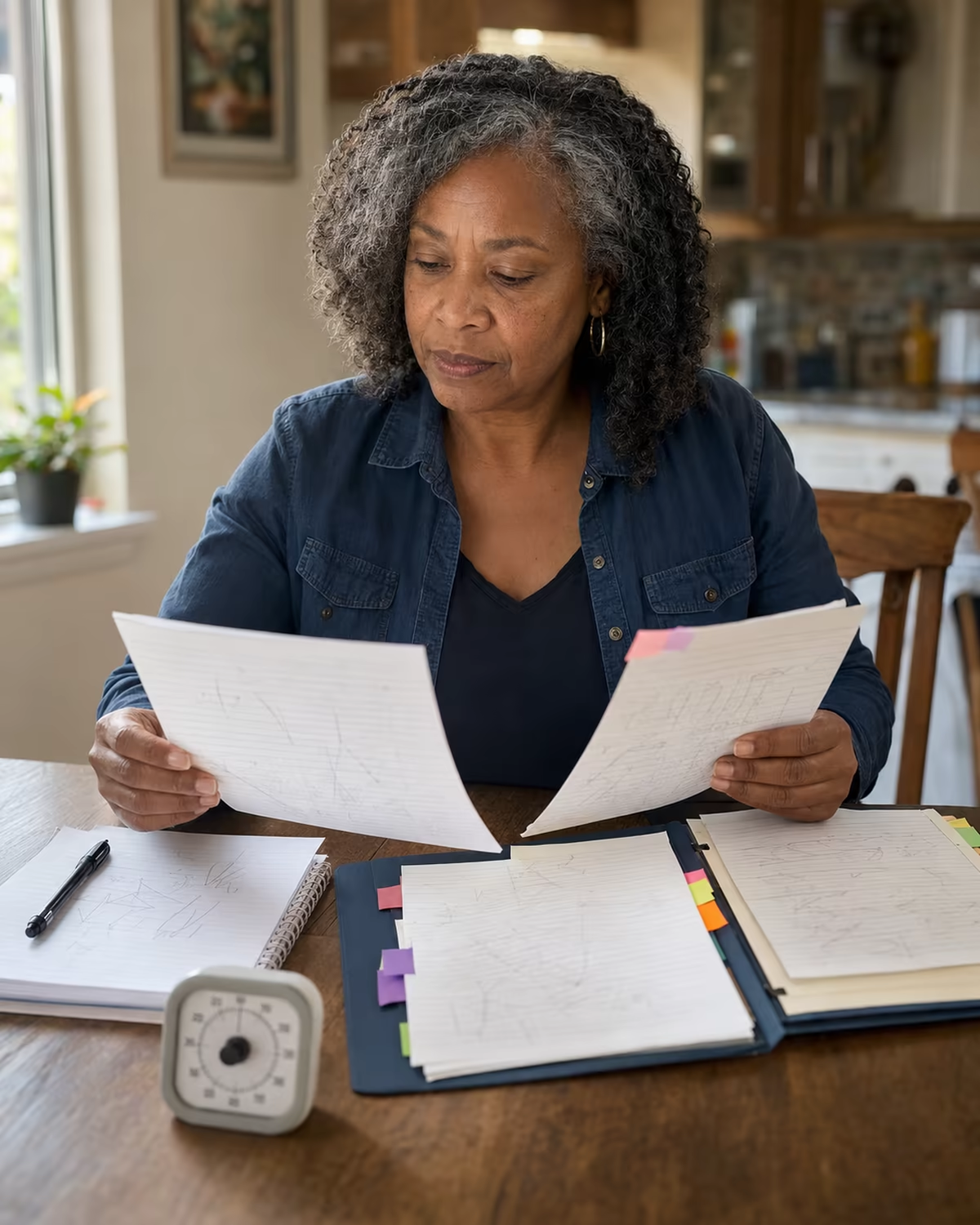
Include dated samples and short notes explaining the conditions and help provided.
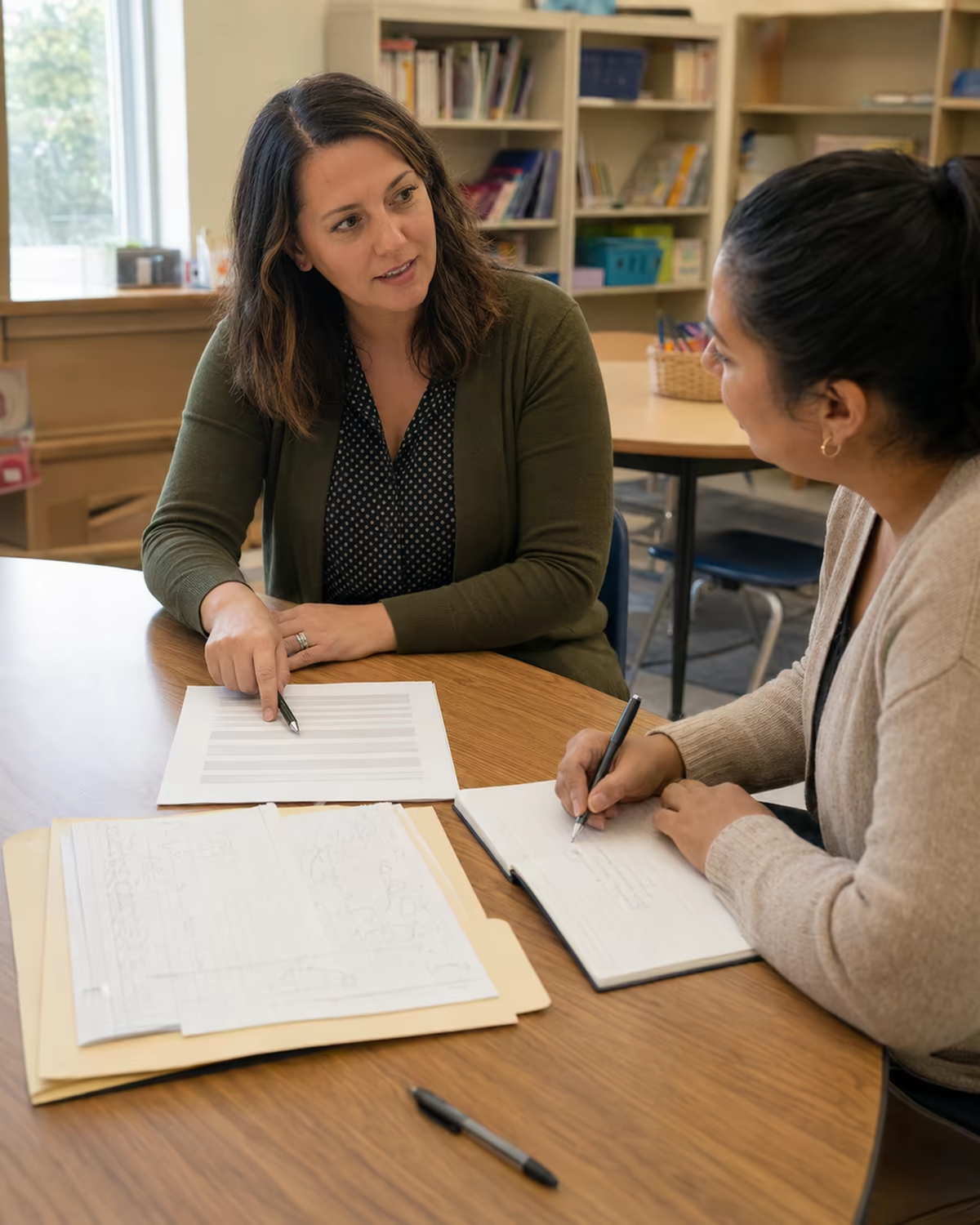
If the district agrees, it can send consent forms. If it declines under IDEA, ask for the reasons and supporting information through Prior Written Notice.
Copy-and-send writing evaluation request
Subject: Evaluation request for [child name], [grade/teacher]
Dear [teacher] and [principal or special education coordinator],
I am requesting a comprehensive evaluation for a possible Specific Learning Disability affecting written expression, along with consideration of an occupational therapy assessment if appropriate. There is a large gap between what [child name] can explain aloud and what [child name] can get on paper. Recent examples include [example]. Writing also involves [time, fatigue, pain, legibility, spelling, or organization - keep what applies]. I am attaching work samples.
Please respond to this request in writing. If the district agrees to evaluate, please send the consent paperwork and explain the next steps. Thank you.
[Your name]
[Date and contact information]
Match the writing barrier to supports worth discussing
Barrier-to-Accommodation Matcher
Note: These are discussion examples, not automatic accommodations. The evaluation and purpose of the assignment should guide the plan.
How should accommodations be written so they are actually usable?
Four vague phrases - and stronger discussion language
Vague versus implementable accommodation wording
Note: These examples are starting points for discussion, not universal legal language. The team should individualize them.
Audit the current plan
Underline every support that does not say when it applies, which tool is allowed, who is responsible, or how much time is provided. Those vague lines become your meeting agenda.
When should typing, speech-to-text, or a scribe be used?
Start with the assignment purpose. Typing, speech-to-text, or a scribe may fit when the task measures knowledge or reasoning. They may not replace handwriting when handwriting is the skill being taught or assessed.
Typing
Speech-to-text
Scribe
Word prediction and spelling tools
Speech-to-text is available on many common phones, tablets, computers, and school platforms. Availability does not automatically make it the right tool; the child needs instruction, practice, and a clear plan for when to use it.

Try one answer without the pencil
Tonight, let your child dictate one homework answer while you type exactly what is said. Compare that answer with the written output the pencil usually allows. Bring both versions to the evaluation.
Can handwriting instruction and accommodations happen together?
Yes. A child may receive handwriting or written-language instruction, OT when appropriate, and accommodations that keep grade-level thinking from being trapped by output speed.
Tools such as typing or speech-to-text can function a little like glasses: they protect access while other skills continue developing. The comparison is not perfect, but the principle matters - help the child participate now while teaching the skills that can grow.
The plan should distinguish assignments that teach handwriting or spelling from assignments that measure science knowledge, reading comprehension, reasoning, or ideas. One should not be allowed to erase the other.
Does dysgraphia need an IEP or a 504 plan?
Schools evaluate writing difficulties under Specific Learning Disability in written expression. Difficulties commonly described as dysgraphia may be supported through that category if the child meets the eligibility criteria. A child who needs specialized instruction or a related service may need an IEP; a child who mainly needs access accommodations may be served through a 504 plan.
Read IEP vs. 504 Plan for the larger comparison. Section 504 procedures vary by district, so ask for the district’s safeguards and process in writing.
Use language that separates knowledge from handwriting
Meeting script: separate knowledge from output
Can we talk about how [child] shows what they know? Right now, handwriting is deciding the grade more than understanding is. I would like the plan to separate assignments that measure knowledge from assignments that directly teach or measure handwriting.
Meeting script: make the accommodation measurable
For each support, can we write down when it applies, which tool is used, who is responsible, and when we will check whether it is working? ‘As needed’ is hard for the student and the teachers to implement consistently.
Ask your child
Choose the next guide that fits
Dyslexia Support at School
Request reading support and make the plan specific.
Dyscalculia in Children
Understand the math pattern and prepare for evaluation.
What to Say at an IEP Meeting
Use calm scripts and get the free IEP Meeting Script Card.
Clear answers without another rabbit hole
Take clearer wording into the meeting.
The What to Say at an IEP Meeting guide includes calm scripts and the free IEP Meeting Script Card.
How this guide was reviewed
Federal sources reviewed
July 2026
Learning-disability sources reviewed
July 2026
Next scheduled review
January 2027
State timelines and local procedures can differ. These sources support the national guidance and educational claims used on this page.

Educational note: This guide provides general educational information for U.S. parents and caregivers. It is not legal, medical, diagnostic, or therapeutic advice. Eligibility, timelines, evaluations, services, and accommodations depend on the child, the evaluation, federal and state law, and local procedures. A federally funded parent center, qualified evaluator, or attorney can help with an individual situation.